Real Estate Careers Without a License: 5 In-Demand Roles You Can Start This Year
Real Estate Careers Without a License: 5 In-Demand Roles You Can Start This Year
Most people assume that working in real estate means becoming an agent. You picture cold calls, open houses, commission-only income, and a license exam standing between you and your first paycheck. That assumption stops a lot of people from ever exploring what is actually a wide-open industry full of stable, flexible, well-paying career paths.
Here is the truth: the real estate industry runs on a behind-the-scenes team of support professionals who make every deal, every listing, and every transaction actually happen. These people are not agents. They do not sell homes. And in most states, they do not need a real estate license to do what they do.
If you have been looking for a career that offers flexibility, remote work, meaningful work, and real income potential — real estate support might be exactly what you have been missing.
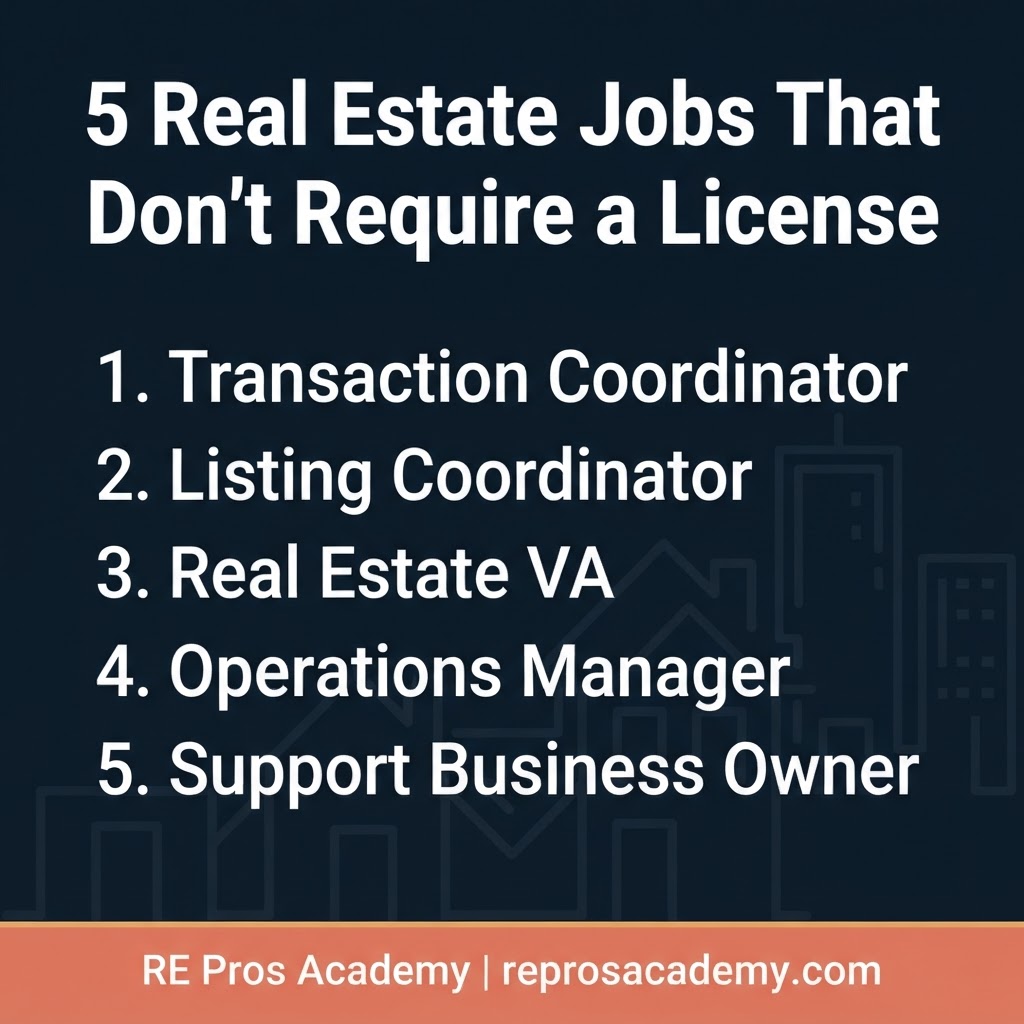
This article breaks down five in-demand real estate careers you can pursue without a license and how to get started with each one.
Why Real Estate Support Careers Are Having a Moment
The real estate industry is growing — and it is getting more complex. Real estate teams are expanding. Brokerages are scaling. Independent agents are handling more transactions than ever before. And all of them need help managing the administrative, operational, and coordination work that keeps their businesses running.
The problem? Most agents went into real estate because they love people and sales — not paperwork and systems. That gap between what agents are good at and what their business demands has created an enormous opportunity for support professionals.
Transaction volume in the U.S. remains in the millions of transactions per year. Each one requires dozens of tasks, dozens of deadlines, and dozens of communications between buyers, sellers, lenders, title companies, inspectors, and agents. Someone has to manage all of that. That someone is not always the agent.
Real estate support professionals are the people who keep real estate businesses organized, efficient, and growing. And demand for them is only increasing.
The 5 Real Estate Support Careers Worth Knowing About
1. Transaction Coordinator
What they do: A transaction coordinator (TC) manages the administrative process of a real estate transaction from the moment a contract is signed to the day a deal closes. They track deadlines, coordinate communication between all parties, organize documents, follow up with lenders and title companies, and make sure nothing falls through the cracks.
Why it matters: Missing a contract deadline in real estate can kill a deal, cost clients thousands of dollars, and damage an agent's reputation. A skilled transaction coordinator protects the agent, the client, and the transaction.
Income potential: Independent transaction coordinators typically charge $300–$500 per transaction file. A TC managing 10–15 files per month can earn $3,000–$7,500 or more. Employed TCs often earn $45,000–$70,000+ annually depending on market and experience.
License required? In most states, no. Always check your specific state's requirements, but the majority of transaction coordination work falls within an administrative scope that does not require a license.
Who thrives in this role: Detail-oriented people who love checklists, organization, and problem-solving. If you have a background in project management, paralegal work, medical administration, or any fast-paced administrative role, you likely already have the foundational skills.
2. Listing Coordinator
What they do: A listing coordinator manages the process of getting a property listed and marketed for sale. This includes coordinating photography, writing listing descriptions, uploading properties to the MLS (when permitted), managing marketing materials, scheduling showings, and keeping sellers updated throughout the listing period.
Why it matters: Listing a home is a multi-step marketing project. Agents who are busy showing homes and generating leads often do not have the bandwidth to manage every listing detail. A listing coordinator makes sure the marketing is sharp, the photos are scheduled, and the seller feels taken care of.
Income potential: Listing coordinators often work as part of a team or independently, charging per listing or on a monthly retainer. Rates typically range from $200–$500 per listing.
License required? In most states, no — as long as the listing coordinator is performing administrative and marketing support tasks, not negotiating or representing the client.
Who thrives in this role: Marketing-minded, organized people who enjoy creative work alongside structured processes. Experience in marketing, communications, or customer service translates well.
3. Real Estate Virtual Assistant
What they do: A real estate virtual assistant (VA) provides remote administrative and operational support to real estate agents, teams, or brokerages. Tasks can include managing email and calendars, social media management, lead follow-up, database management, content creation, bookkeeping support, and general administrative work.
Why it matters: Real estate agents are notoriously overwhelmed. Between lead generation, client management, showings, and closings, the administrative work piles up fast. A skilled VA frees agents up to focus on what generates income — while the VA handles everything else.
Income potential: Real estate VAs typically charge $20–$60+ per hour depending on their skill set and specialization. A full-time VA client load can generate $3,000–$8,000+ per month.
License required? No license required. This is purely administrative and operational support.
Who thrives in this role: Self-starters who are comfortable working independently, managing their own time, and communicating clearly in writing. If you are tech-savvy, organized, and good at juggling multiple tasks, this role is a natural fit.
4. Real Estate Operations Manager / Director of Operations
What they do: A real estate operations manager oversees the internal systems, processes, and people that keep a real estate team or brokerage running. They manage staff, build SOPs (standard operating procedures), track KPIs, handle onboarding, manage vendor relationships, and ensure the business runs efficiently behind the scenes.
Why it matters: As real estate teams grow, they need someone whose full-time job is making sure the business actually works. The operations manager is often the person who turns a chaotic, agent-led team into a scalable, systemized business.
Income potential: Operations managers in real estate typically earn $55,000–$100,000+ annually, depending on team size and market. This is one of the highest-earning support roles in the industry.
License required? Typically no. While some brokerages prefer licensed staff, many operations roles are open to experienced operators who bring business management skills.
Who thrives in this role: People with a background in operations, business management, HR, or team leadership. If you have run departments, built processes, or managed people — this career path might be your highest-leverage move into real estate.
5. Real Estate Support Business Owner
What they do: Rather than working for one agent or team, some professionals build their own real estate support businesses — offering TC services, listing coordination, VA services, or full-service operations support to multiple clients at once.
Why it matters: Building a business rather than taking a job creates unlimited earning potential, complete schedule flexibility, and the ability to choose your clients and niche. Many of the most successful people in real estate support have built six-figure businesses serving real estate professionals across the country — entirely remotely.
Income potential: Highly variable, but real estate support business owners commonly earn $60,000–$150,000+ annually once established. Some surpass this significantly.
License required? No license required for the support business itself. Specific services may have state-specific considerations, so always research your state.
Who thrives in this role: Entrepreneurial people who want freedom, flexibility, and the ability to build something of their own. This path requires business development skills on top of the core service skills.
Common Mistakes People Make When Entering Real Estate Support
Assuming you need a license for everything. Many people eliminate themselves from these careers before ever researching their state's actual requirements. Do your research — you may be more eligible than you think.
Thinking you need real estate experience first. You do not. Your transferable skills from other industries — healthcare, law, education, finance, project management — are genuinely valuable in real estate support roles.
Undervaluing your services from the start. One of the biggest mistakes new transaction coordinators and VAs make is pricing too low out of fear. Know your value. Price it accordingly.
Trying to do everything at once. Pick one role, master it, and build from there. Trying to offer every service before you have depth in any of them leads to burnout and mediocre work.
Skipping education and training. Real estate has its own language, its own processes, and its own standards. Getting proper training before you start working with clients is the difference between confidence and confusion.
Frequently Asked Questions
Do I need any experience in real estate to start?
No. Many people who become transaction coordinators, real estate VAs, or listing coordinators come from completely unrelated fields. What matters more is your organizational skills, attention to detail, communication ability, and willingness to learn the industry.
Can I really work from home in real estate support?
Yes — the vast majority of real estate support work is done remotely. Transaction coordinators, listing coordinators, and VAs routinely work from home with clients across the country.
How long does it take to start earning income?
With the right training, many people land their first client within 30–90 days of starting. Building to a full income takes longer and depends on how quickly you market yourself and grow your client base.
What if I eventually want to get my real estate license?
Many real estate support professionals choose to get their license after building experience in the industry — and they enter with a massive advantage. Understanding how transactions work from the inside out makes them better agents from day one. That said, a license is absolutely not required to build a successful career in real estate support.
Is real estate support work stable?
Real estate is cyclical, but the need for support professionals is consistent. In slow markets, agents need help staying organized and efficient. In hot markets, they need help managing volume. Skilled support professionals are valuable in any market condition.
Where to Start
If any of the five roles above caught your attention, here is a simple path forward:
- Research your state's requirements for the specific role you are interested in.
- Inventory your transferable skills — you likely have more than you think.
- Get educated on real estate processes, contracts, and terminology — this is non-negotiable.
- Choose a niche — pick one role and focus on it first.
- Build your first client relationships — start local, start small, and grow from there.
The real estate industry is not just for agents. There is an entire economy of support professionals who help this industry run — and there is room for you in it.
Ready to build your future in real estate support? Explore RE Pros Academy and learn how to create a flexible career or business — without ever getting a license or making a single cold call. Explore RE Pros Academy →
Ready to Build Your Real Estate Career?
Get lifetime access to courses, templates, systems, and a community of real estate professionals.
Explore Membership Options